Skip to product information
1 of 2

Hakam Din

J. J. Quantz 1750 after Dayton C. Miller Collection - A=415 Hz

J. J. Quantz 1750 after Dayton C. Miller Collection - A=415 Hz

Regular price $865.00 CAD
Regular price Sale price $865.00 CAD
Sale Sold out
Shipping calculated at checkout.
Wood
Quantity
View full details
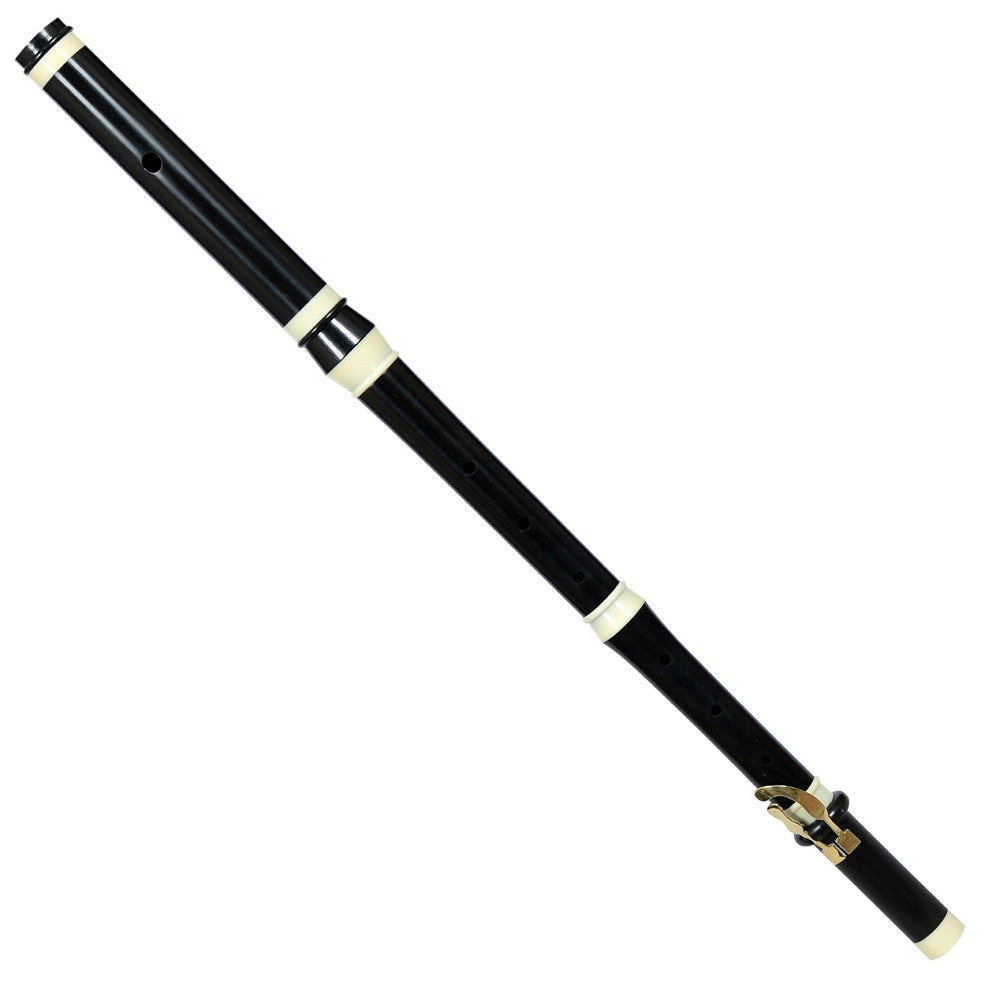
Our traverso reproduction is based on an original J. J. Quantz flute, Potsdam, dating from around 1750, preserved in the Dayton C. Miller Collection (DCM 916) at the Library of Congress, Washington, D.C.

At the court of Frederick II of Prussia, Quantz served as court flutist, teacher, and instrument maker, it represents Berlin flute making at the height of the late Baroque period. Instruments of this type were central to the musical life of Frederick’s court and reflect the playing style described in Quantz’s treatise.

A=415 Hz - The flute is tuned to Baroque pitch with a 10 mm tuning-slide opening.

You have the option of olive, cocobolo or grenadilla wood. Carefully selected wood, the rings are individually hand-crafted from cocobolo wood or imitation Ivory, adding a distinctive contrast and elegant appearance while giving the instrument an added sense of craftsmanship and value.

The D foot joint has two brass Eb and D# keys mounted on a hand-carved key block made directly from the wood body. The keys are cast in brass and left in its original finish, fitted with a brass pin, steel spring, and leather pad.

The traverso comes complete with a fingering chart, care instructions, a care kit and a case.

The Legacy of Johann Joachim Quantz: 

  • Quantz was one of the most important flute virtuosos and theorists of the 18th century. A central figure in European musical life, he is renowned not only for his compositions but also for his influential treatise “On Playing the Flute” (1752), one of the most important sources on 18th-century performance practice and flute technique. The treatise remains an essential reference for historically informed performance, offering detailed insight into Baroque and early Classical flute technique, articulation, and musical expression..
  • Quantz served as flute teacher, composer, and court musician to Frederick II of Prussia, with their close musical association beginning in the 1720s and continuing throughout Frederick’s reign. His pedagogical and musical influence shaped the Berlin flute tradition and court style of performance.
  • Several original flutes associated with Quantz’s circle survive today, many preserved in the collection of Frederick the Great, reflecting the high level of craftsmanship and refinement of the Berlin school.

Quantz’s Innovations in Flute Design:

  • During the 1730s and 1740s, Quantz was closely involved in the refinement of flute construction, contributing significantly to the evolution of the instrument’s design and performance capabilities. Quantz’s legacy includes the development of the adjustable headjoint, often referred to as the “slide head." This innovation allowed flutists to make fine pitch adjustments, improving intonation across different tonalities. This principle remains fundamental to modern flute design.
  • Quantz also added an E-flat key on the foot joint in some instruments of the Berlin tradition. This innovation enhanced technical ease and expanded expressive possibilities, and represents an important step in the gradual development of the keyed flute.

    • 5 stars: 1 (100%)
    • 4 stars: 0 (0%)
    • 3 stars: 0 (0%)
    • 2 stars: 0 (0%)
    • 1 star: 0 (0%)
    J
    John B
    Flute with a soul

    This is an initial review, since the flute is not fully played in yet. I have been curious for some time about Quantz flutes, with their wide bores, tuning slides, and enharmonic D#/Eb keys. I wasn't prepared to pay $3,000+ to a specialist maker (I don't play well enough yet to deserve it), but when I saw this listed it was almost an impulse buy. It would be unfair to compare this flute to an expensive, dead accurate copy by a specialist, but so far I am quite happy with it--I love the tone and responsiveness. The finish is good overall, particularly the smooth bore, which seems to be accurate to Quantz. The tone holes are not undercut, and there is no screw cork; instead, the wooden head cap has an integral plug lapped with thread, making it easy to change the plug's position when changing the middle pieces (corps de rechange) to change pitch. If you prefer to insert your own cork, the finial in imitation ivory at the end makes the flute look finished even without the head cap. Pitch is pretty much dead on at A = 415 Hz and A = 440 Hz with the two corps de rechange supplied, but I find the flute plays better at A = 415 Hz, which I prefer (better than compromising both pitches, and I would rather play at the lower). Some Quantz flutes survive with many corps de rechange, but he himself preferred a lower pitch, A = 392-398 Hz, like the French flutes (which first inspired him to play the flute) sound best at. A fingering chart was not included, and the one in the Quantz Versuch (either the German facsimile or the Reilly translation) should be consulted. It is also available on a couple of web sites. I prefer my own fingering to Quantz's for only one pitch so far (low G# without RH3), but such things are not unusual with one-keyed flutes. The fingerings for whistles, six-hole keyless flutes, the Aulos Grenser and Stanesby flutes, or the Ralph Sweet baroque flute will not work for some chromatics or parts of the higher register (partly the effect of the wider bore). As with any one-keyed flute, it pays to investigate alternatives for both pitch and ease of passagework. Quantz gives enharmonic fingerings and didn't expect his flutes to be played in even temperament (hence the D#/Eb keys, which Tromlitz also recommended). Margaret Neuhaus' The Baroque Flute Fingering Book is a worthwhile investment if you are serious about the traverso, as, of course, are the Quantz and Tromlitz books.