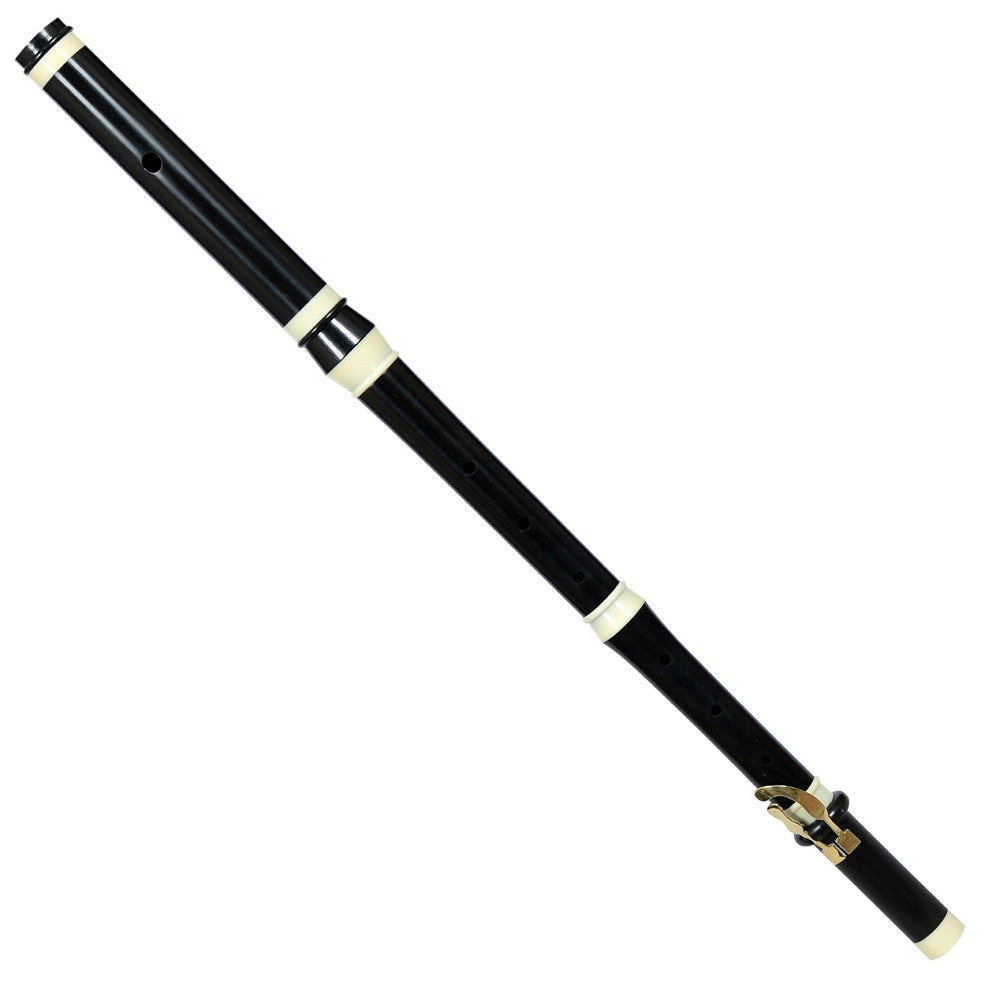
Il s'agit d'un premier avis, car la flûte n'est pas encore complètement rodée. Je m'intéresse depuis un certain temps aux flûtes Quantz, avec leur large perce, leurs coulisses d'accord et leurs clés enharmoniques en ré dièse/mi bémol. Je n'étais pas prêt à payer plus de 3 000 dollars à un fabricant spécialisé (je ne joue pas encore assez bien pour le mériter), mais quand j'ai vu cette annonce, j'ai presque craqué pour un achat impulsif. Il serait injuste de comparer cette flûte à une copie coûteuse et parfaitement fidèle réalisée par un spécialiste, mais jusqu'à présent, j'en suis très satisfait : j'adore le son et la réactivité. La finition est globalement bonne, en particulier le tube lisse, qui semble fidèle à Quantz. Les trous ne sont pas sous-coupés et il n'y a pas de bouchon à vis ; à la place, le capuchon en bois est muni d'un bouchon intégré avec un filetage, ce qui permet de changer facilement la position du bouchon lorsque l'on change les pièces intermédiaires (corps de rechange) pour modifier la hauteur. Si vous préférez insérer votre propre bouchon, le pommeau en imitation ivoire à l'extrémité donne à la flûte un aspect fini même sans le capuchon. La hauteur est pratiquement parfaite à A = 415 Hz et A = 440 Hz avec les deux corps de rechange fournis, mais je trouve que la flûte joue mieux à A = 415 Hz, ce que je préfère (mieux que de faire un compromis entre les deux hauteurs, je préfère jouer à la plus basse). Certaines flûtes Quantz ont survécu avec de nombreux corps de rechange, mais lui-même préférait une hauteur plus basse, A = 392-398 Hz, comme les flûtes françaises (qui l'ont d'abord inspiré à jouer de la flûte) qui sonnent le mieux. Aucun tableau de doigté n'était inclus, et il convient de consulter celui du Quantz Versuch (soit le fac-similé allemand, soit la traduction de Reilly). Il est également disponible sur plusieurs sites web. Je préfère mon propre doigté à celui de Quantz pour une seule note jusqu'à présent (sol dièse grave sans RH3), mais ce genre de choses n'est pas inhabituel avec les flûtes à une clé. Les doigtés pour les sifflets, les flûtes à six trous sans clé, les flûtes Aulos Grenser et Stanesby, ou la flûte baroque Ralph Sweet ne fonctionnent pas pour certains chromatiques ou certaines parties du registre aigu (en partie à cause du diamètre plus large). Comme pour toute flûte à une clé, il est utile d'étudier les alternatives tant pour la hauteur que pour la facilité des passages. Quantz donne des doigtés enharmoniques et ne s'attendait pas à ce que ses flûtes soient jouées en tempérament égal (d'où les clés D#/Eb, également recommandées par Tromlitz). Le livre de Margaret Neuhaus, The Baroque Flute Fingering Book, est un investissement utile si vous vous intéressez sérieusement à la flûte traversière, tout comme, bien sûr, les livres de Quantz et Tromlitz.